
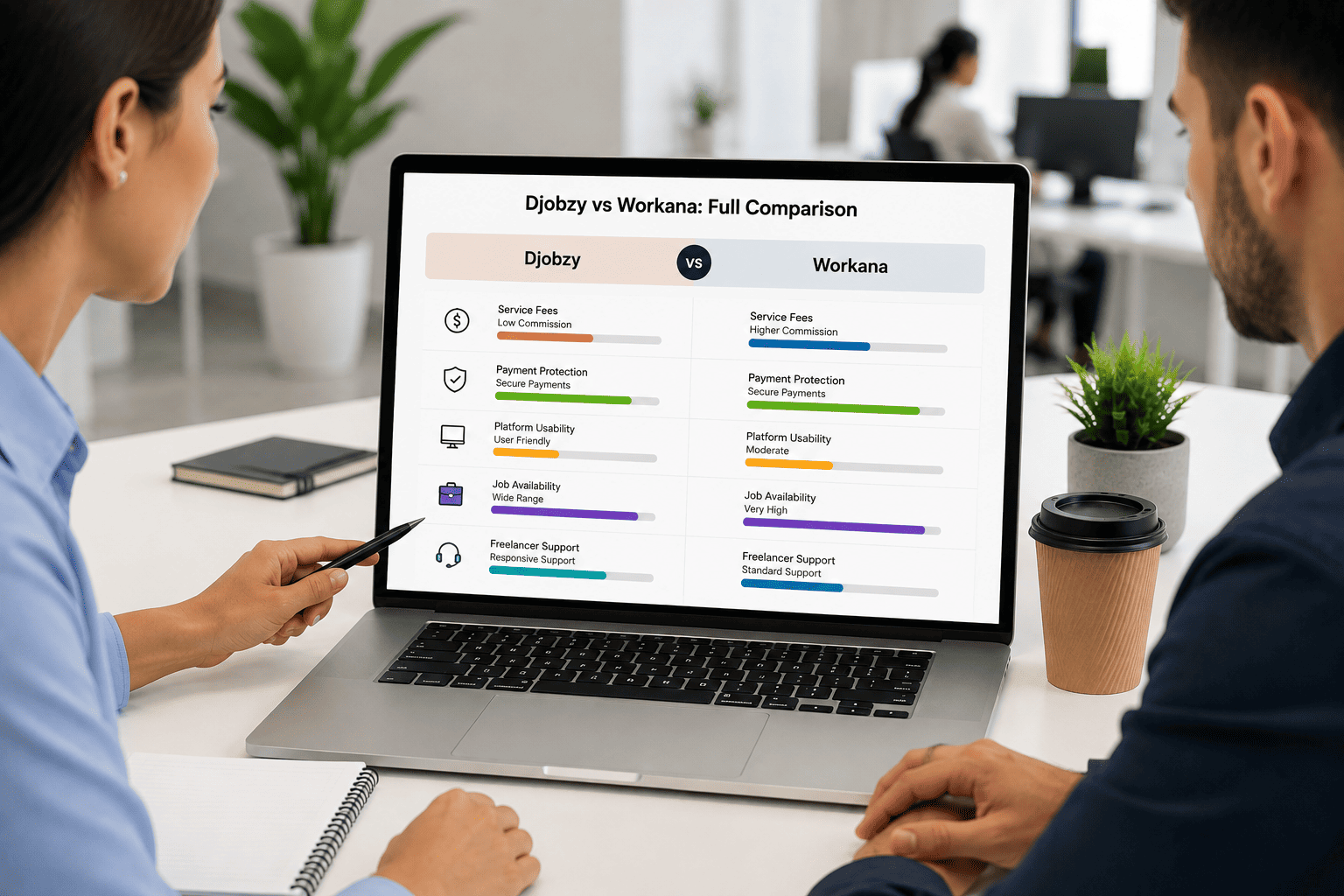
Djobzy is a location-based work and services marketplace with live-map discovery where workers keep 100% of the agreed price. Workana is a Latin America-focused freelance marketplace where freelancers pay a tiered commission based on how much they’ve earned from each individual client over time.
The two platforms both help freelancers get remote work — but Workana’s take-rate on the freelancer side changes over the life of a client relationship, while Djobzy’s is zero across every job. That difference matters when you’re trying to model earnings. Here’s the fact-by-fact comparison.
Reviewed by the Djobzy team · Updated 24 July 2026 · All comparisons →
Djobzy
Zero commission, local plus remote
Workers keep 100% of the agreed price. Employers pay a 15% platform fee. Discovery via live map.
Workana
LatAm freelance marketplace, tiered fee
Freelancers pay 20% on the first $300 with a new client, dropping to 10% then 5% as the client relationship grows.
Djobzy vs Workana: side by side
Ten dimensions, no winner declared. Sources are numbered and listed at the end.
Marketplace type
Djobzy
Location-based work and services marketplace with live-map discovery. Covers local and remote work in one profile.
Workana
Bid-based remote freelance marketplace founded in Buenos Aires in 2012. Focused on Latin American freelancers serving clients regionally and globally.1
Scope
Djobzy
Local and remote work. Jobs, services, freelance and shift work — and one profile covers all of it.
Workana
Remote digital work: development, design, marketing, writing, translation, admin, finance, legal. Also runs a Certified Devs tier for pre-vetted engineering talent. In-person or local-services work is not the platform’s focus.2
What the freelancer or worker pays
Djobzy
Zero commission
Workers keep 100% of the agreed worker price. No bidding fees, no membership tiers, no proposal quotas.
Workana
20% / 10% / 5% tiered by client
Workana’s freelancer commission depends on how much has been billed to that specific client over time: 20% on the first $300, 10% from $300 to $3,000, then 5% above $3,000. The counter resets per client — a new client starts at 20% again.3
Paid freelancer plans exist but don’t reduce the commission itself.
What the client or employer pays
Djobzy
15% platform fee
Charged on top of the agreed price and visible before you confirm. Current pricing is published at djobzy.com.
Workana
4.5% service fee
Clients pay a 4.5% service fee per contract, with a $2 minimum. Free to post projects and review proposals; the fee is triggered on contract creation. Payment-processing costs vary by country and method.4
Payment protection
Djobzy
Payment is held in escrow until the job is completed. Workers are paid on completion; clients are protected until then.
Workana
Workana holds client funds until deliverables are approved. Dispute resolution is handled internally by Workana’s team through the contract-arbitration process.5
How people find each other
Djobzy
Live map with active listings and provider profiles visible by location. Providers can be discovered directly, without needing to submit a proposal.
Workana
Proposal-based: clients post projects, freelancers submit written proposals with price and timeline. Some plans include additional proposal credits and profile boosts.6
Verification
Djobzy
Seven levels: email, phone, social, address, government ID, payment card, and interview plus third-party background check.
A trust signal, not a guarantee of safety, character or competence.
Workana
Profile-based reputation. The Certified Devs tier applies additional structured screening for engineering roles. No standard identity or background check across all freelancers.7
Reputation portability
Djobzy
Career Passport — a portable professional record carrying reputation, reviews, experience and work history across locations and opportunities.
Workana
Reviews and ratings live on the Workana profile. No public statement found describing reputation as portable off-platform.8
Repeat work
Djobzy
Employers can build a trusted list over time and re-hire directly. No new proposal cost. Workers keep a portable Career Passport that grows with each engagement.
Workana
The tiered commission is designed to reward repeat work — the more a client pays a specific freelancer, the lower the freelancer’s rate becomes on that relationship (from 20% down to 5%).9
Where it works
Djobzy
Live map active globally. Local work concentrated in focus markets (Vancouver, Toronto); remote work open worldwide.
Workana
Global, but heavily concentrated in Latin America. Around 2 million registered freelancers as of 2026. Projects often require Spanish or Portuguese.10
What you actually take home
Workana’s fee depends on how much you’ve already billed to a client. On a brand-new client relationship, you’re at 20%; long-term relationships drop to 5%. Below is the take-home on a new-client scenario.
The project pays
$300
On Djobzy
Project pays
$300
Commission you pay
$0
You take home
$300
On Workana (new client)
Project pays
$300
Tiered fee (20% / 10% / 5%)
−$60
You take home
$240
Note: Workana’s freelancer fee is 20% on the first $300 with a new client, 10% on the next $300–$3,000, then 5% above $3,000. The calculator applies each tier as your project crosses those thresholds, so a $3,000 first project pays $60 (20% on first $300) + $270 (10% on next $2,700) = $330 fee total. The counter resets each time you take on a new client.
Illustrative comparison at Workana’s official commission tiers, not a quote. Verified 24 July 2026.
Which situation fits which platform
Workana may fit better if
You're a Spanish- or Portuguese-speaking freelancer targeting Latin American clients, or a client looking for LatAm talent at regional pricing, and you're comfortable with a proposal-and-bidding model with tiered fees that reward long-term client relationships.
Djobzy may fit better if
You want to keep 100% of what you agree on every project, not just after you've paid Workana enough to hit lower tiers. Or you want to be discovered on a live map rather than winning bids on written proposals, and you want one profile that covers both local and remote work.
Tiered vs. flat
Workana's tiered model rewards you for staying with the same client for a long time. Djobzy's zero-commission model rewards you every time, on every job, without needing to hit a lifetime-billing threshold first.
Zero commission on every job
No tiers to climb, no bidding to win.
Workers pay zero commission. Employers pay a 15% platform fee, visible before you confirm.
Frequently Asked Questions
Related comparisons
Looking at Djobzy alongside another platform? These may help:
About Djobzy
Djobzy is a location-based work and services marketplace with live map discovery. It connects people who need work or services completed with workers, freelancers, professionals and service providers who can provide them locally or remotely. Users can find opportunities, hire help, offer services and build portable reputation through Djobzy's Career Passport. Workers pay zero commission and keep 100% of the agreed worker price, while employer and client platform pricing applies.
Sources and verification
All Workana figures verified 24 July 2026. Platform terms, fees and features change — confirm current details directly with each platform before deciding.
1, 2. workana.com about pages and category structure
3. help.workana.com/hc/en-us/articles/360041235874 (How is the commission calculated at Workana)
4. help.workana.com/hc/en-us/articles/360040846094 (client service cost 4.5%, $2 minimum)
5. Workana Terms of Service and dispute-arbitration documentation
6. Independent 2026 reviews of Workana proposal UX (Tecla, EarnifyHub, Flexiple)
7. Certified Devs program pages on workana.com
8, 9. Workana Terms of Service on off-platform contact; commission-tier structure documented in help.workana.com
10. Tecla 2026 review reporting ~2 million registered freelancers and LatAm concentration








0 Comments